
Actuators
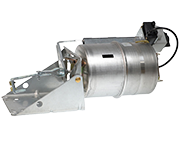
Industrial Actuators for Motion Control and Automation Systems
An actuator is a component designed to move or control a mechanism or system. Actuators require both a control signal and an energy source. When the actuator receives the correct command signal, it converts the supplied energy into mechanical motion, enabling controlled movement in industrial equipment and automated systems.
Industrial actuators are widely used to produce either linear or rotary motion depending on application requirements. Many actuator systems are integrated with motor and drive control systems to provide precise positioning, speed regulation, and automated process control.
Most industrial actuators are pneumatic actuators, which use pressurized air to drive motion. Pneumatic actuators are commonly selected for applications that require fast response times, simple control, and reliable start and stop operation. Key performance characteristics include stroke length for linear actuators, torque output for rotary actuators, and maximum operating pressure.
In general, actuators are classified based on output force, operating speed, motion type, and environmental conditions. Proper actuator selection is critical to ensure sufficient force to move the load, appropriate response time for process requirements, and compatibility with the operating environment.
Other actuator technologies include hydraulic actuators, electric actuators, thermal actuators, magnetic actuators, and mechanical actuators. Hydraulic actuators are typically used in high-force applications such as heavy machinery and material handling systems. Electric actuators are commonly used in automation systems where precise position control and programmable motion are required.
Certain actuators are designed for specialized tasks. Valve actuators, for example, are used to open and close process valves in fluid control systems.
Damper actuators are commonly used in HVAC systems to control airflow by positioning ventilation dampers, including fire and smoke dampers used in safety systems.
Actuators play a critical role in industrial automation by enabling controlled motion, improving process accuracy, and supporting reliable machine operation.
Frequently Asked Questions
What is the difference between linear and rotary actuators?
Linear actuators produce straight-line motion, while rotary actuators produce rotational motion used for turning shafts, valves, or positioning mechanisms.
When should hydraulic actuators be used instead of pneumatic actuators?
Hydraulic actuators are preferred in applications requiring higher force output, smoother motion under heavy loads, or precise control of large mechanical systems.
What factors determine actuator sizing?
Actuator sizing depends on required force or torque, stroke length, operating speed, duty cycle, mounting configuration, and environmental conditions.
How is actuator speed controlled?
Speed can be controlled by regulating air flow in pneumatic systems, hydraulic fluid flow in hydraulic systems, or voltage and frequency in electric actuator systems.