
Bridge Rectifiers
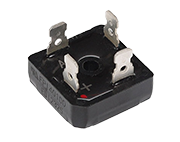
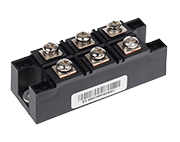
Bridge Rectifiers for AC to DC Power Conversion
Bridge rectifiers are semiconductor devices used to convert alternating current into direct current through full-wave rectification. A bridge rectifier uses a diode bridge configuration to direct both halves of the AC waveform into a DC output from a two-wire AC input, making it a common solution for power supplies, battery chargers, motor drives, control circuits, and industrial electronic equipment.
Compared to some transformer-based rectification approaches, bridge rectifiers can provide a low-cost, low-weight method for converting AC input power into usable DC power. They are most commonly built into or wired in line with power supplies, where the rectified output may then be filtered, smoothed, regulated, or otherwise conditioned by additional circuit components depending on the application.
Single phase standard diode bridge rectifiers are commonly used in power supplies, small equipment, control panels, and general-purpose rectification circuits. Three phase standard diode bridge rectifiers are used in higher-power industrial applications where three-phase AC must be converted to DC, such as DC drives, rectifier assemblies, power conversion systems, and industrial machinery.
When selecting a bridge rectifier, important considerations include maximum average rectified current, maximum reverse voltage, repetitive peak reverse voltage, surge or peak current rating, forward voltage drop, maximum reverse current, thermal resistance, and package style. Available ratings can support rectified current as high as 1000A, with voltage ranges from less than 1V to 1.1kV, depending on the device. The bridge rectifier must be properly rated for the input voltage, load current, fault conditions, and operating temperature of the circuit.
Heat dissipation is especially important in higher-current applications, where bridge rectifiers may require heat sinks, panel mounting, or airflow to maintain reliable operation. Bridge rectifiers are often used alongside other semiconductor components such as diodes, SCRs, transistors, and power modules depending on the circuit design and level of power control required.
Proper selection helps ensure efficient AC to DC conversion, stable circuit performance, and long-term reliability in industrial power and control applications.
Frequently Asked Questions
Does a bridge rectifier produce pure DC output?
No. A bridge rectifier produces pulsating DC output. Additional filtering components, such as capacitors or inductors, are often used to smooth the output for applications that require steadier DC voltage.
Can a bridge rectifier fail partially?
Yes. One or more internal diodes can fail while others remain functional. Partial failure can cause reduced output, excessive ripple, overheating, blown fuses, or unstable DC power.
What causes excessive heating in a bridge rectifier?
Excessive heating can result from high load current, insufficient heat sinking, poor mounting, high ambient temperature, inadequate airflow, or operation above the device's ratings.